
Drywall is Not Brain Surgery or Free Climbing
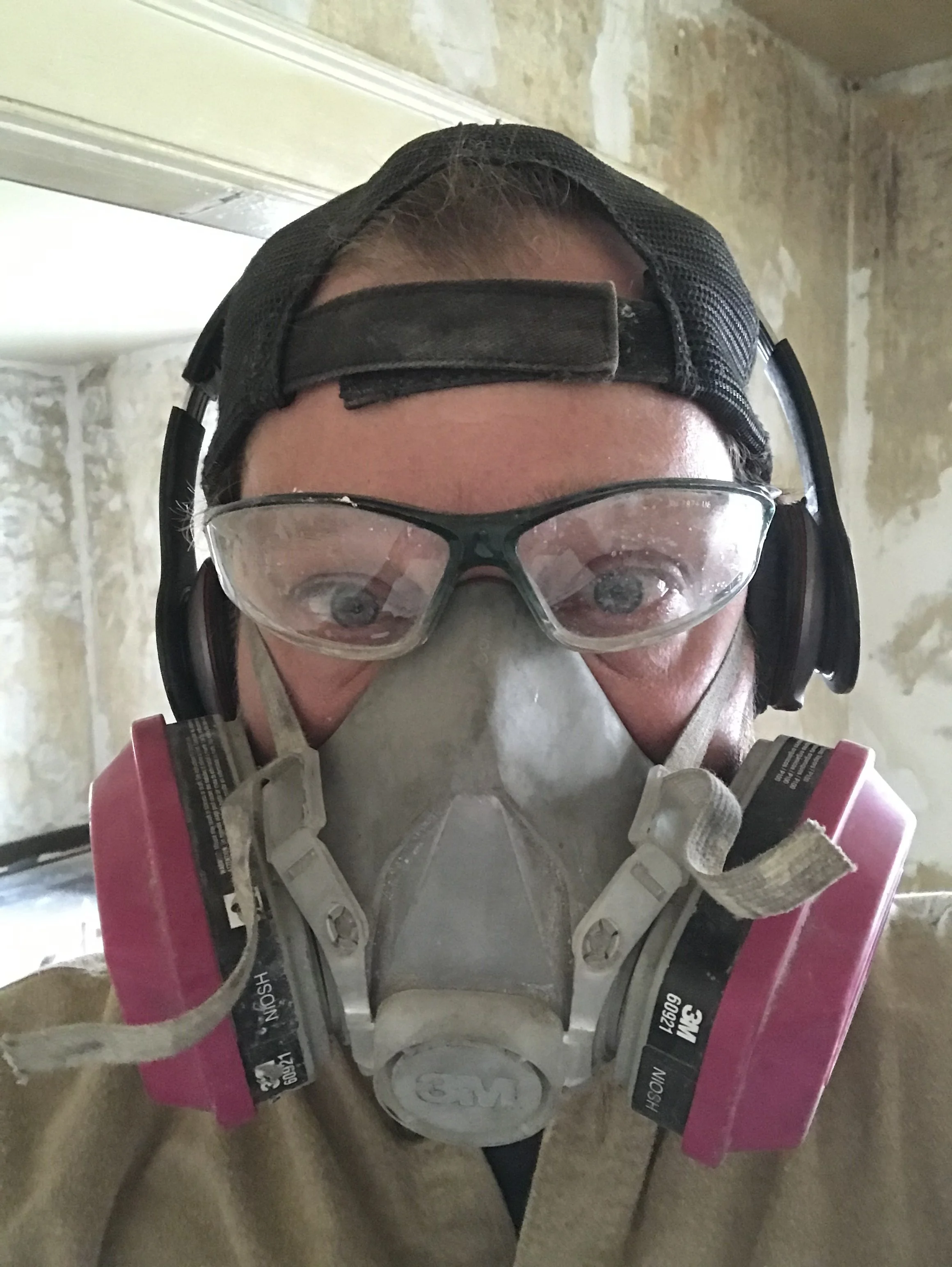
“I don’t do drywall.” So many otherwise very skilled friends take up this stance and I’m not sure why. Sure, it’s not a job without its learning curve. And sure, it’s extremely messy. But the hustle is about being willing to get messy. Much of the money we pay to contractors is about avoiding messes. Here’s a life hack: there is money to be made, and saved, by possessing a willingness to deal with messes.
Drywall is a mess, for certain. Like life itself. But like life itself, drywall can be done alone if need be, and like life itself, the big pieces and small pieces to be hung are approximately the same amount of effort. No matter the size, a mess is going to happen. This can be a barrier.
And it’s not great for your health. I, as with countless others worldwide, embraced better respiratory health after the pandemic, now that N95 is a household name. The dust is the sort that not only gets into every available crack and crevice in the house; it also will get into every alveolus in your lungs if you don’t mask up.
Don’t forget your eyeballs either. The nature of sanding drywall is that you need to be able to see what you’re doing so that the final surface is as flawless as possible. That means working with your face and eyeballs close to the work, and if you happen to be sanding a ceiling, your eyeballs are a magnet for drywall dust in the same way your black pants are a magnet for your yellow lab’s hair.
Getting dirty feels good. It’s a badge of honor of sorts. It represents the hustle and all of its crappy days that you don’t want to recall but need to. As much as I repeat the mantra of “I can do this,” there should be no misgivings about the sheer volume of crap moments of work like this. Not that drywall work is crap; it isn’t. It is, on average, fun. That’s the key: on average. Most renovation work is really fun, on average. And the crappy aspects of it should not be concealed. There are going to be some parts of the jobs that are unglamorous and unappealing and unskilled. Getting very messy is a good reminder to me that if I am willing to do the work that most people don’t want to do, that’s money in the bank.
So if the plan is to start from scratch, the first bit you’ll be doing is making sure that your surface preparation is complete. That means bare studs free of any of the old nails or screws. Sometimes, if it’s an old house, the studs themselves might need to be planed down so that the drywall doesn’t appear wavy. Before new drywall goes up, deal with any electrical work that needs done. And maybe the insulation needs to be replaced, or maybe there isn’t any at all. Get that sorted, then start making walls.
Carrying a 4’ x 8’ sheet of drywall requires a certain “man strength,” as my son would call it. You can be a strong and stout dude, but figuring out how to carry such an awkward load will take some practice. It’s about spreading your hands wide and keeping your back straight. You’re gonna feel it. But even this older guy just graduated to 4’ x 12’ sheets. When (not if) you bash the corner of a sheet into a wall or the floor, don’t sweat it. No one wants a marred up piece of anything, but drywall is nothing if not very forgiving. Any flaw can be easily fixed with a little more mud and sanding.
I’ve made every mistake with drywall, many visible in my own home, which means I get that visual reminder every day of what imperfect looks like. It’s a good motivator. The thing about drywall is that it takes patience, and not because it’s a long drying or curing time; it’s not. It’s the accompanying mess that comes along with sanding. There are going to be three coats of mud applied in sequence along the joints and each one requires sanding in between. I’ve talked about the dust. It covers every surface and penetrates every nook and cranny, so when you’re living in such a construction zone, there’s an eagerness to get out of it. Wrap it up. Clean it up. Let’s say you do three coats of mud and you sand it and tear down the plastic sheeting and wipe everything down and then…. You see it. An imperfect spot. It’s not like opening up a can of paint and touching it up real quick. It’s more mud, more dust, more sorrow. And if you’ve already put primer over it, just walk away because there ain’t no going back without starting over.
This potential for imperfection doesn’t dissuade me from doing this or most any other type of work on my own house. But I am a forest for the trees kind of a guy. The overall improvements outweigh the very minor imperfections by a Sunday mile. Perfectionism keeps a great many people from taking on a great many things and I for one am not about to let it stop me from improving a property. And for what it’s worth, the feedback I get from others whose opinion I trust is that the work that I do is good work.
Some jobs demand perfection— like brain surgery and free climbing. But neurosurgeons and free climbers only got to where they are by training with support. Every project I take on amounts to training. I may arrive at a place where I cannot find a single flaw in a wall or floor or whatever, but in the meantime, each attempt in that progression offers valuable practice and feedback about my efforts and skills to date.
One of my unconscious habits, and likely that of a lot of builders, is to inspect the work everywhere I go. When I’m using a restaurant bathroom I inspect the tile, grout, and caulk. In other people’s houses I internally critique their baseboards and drywall. My observations have led me to conclude that there is a lot of corner cutting and shoddy workmanship out there and it still gets paid for and overlooked by a lot of the world. This is sad. Not tragic, but sad. We can do better. There are not enough of us doing the work of improving houses and a great lot of the ones that are could stand to slow down and maybe get a little more feedback. All this is to say that when I look at the imperfections in my own work I know where I stand in the continuum of craftsmanship and I’m comfortable with it. That of course presumed that I will improve more, in a gradual progression. None of us should wait to become experts to start on a thing. When we do, we end up doing nothing.